The story of the prayer nut
From a medieval work of art in the Rijksmuseum to a travel altar for everyday use.
History
The prayer nut was already in use in the first century AD, whilst Jesus was still walking the earth. This became clear to me after I had been making prayer nuts for several years. During a presentation at a market, I met a refugee from Syria. He told me that the use of prayer nuts is still practised today by the Orthodox Christian Church in Iraq. This community originated around the year 70, making it almost 2,000 years old. This was a result of the Roman persecution of the early Christians in and around Jerusalem. The believers were forced to flee, and on their journey they shared why they had come to faith in Jesus – Jesus, the Way, the Truth and the Life. This marks the beginning of the Assyrian Orthodox Church, where James brought the Good News. In the New Testament of the Bible, you will find the Book of James. In this church, the prayer nut has been in use since its very inception. The custom amongst these believers was that the prayer nut was carried in a special pocket of the priest’s robe and was only opened during a sacred church service, such as at Easter, Pentecost or Christmas. The European Christian church was in a state of constant flux. There were also events that caused distress. This led to unrest. Consequently, people began to meet in secret. With sincerity, the living God, Creator of heaven and earth, was worshipped and honoured, and the teachings of his Son Jesus were imparted. This personal experience of faith was complemented by an object that gave its wearer a deep sense of connection with God the Father: the prayer nut.
My journey
I have an inquisitive nature; I want to know and understand. That makes me something of a pilgrim. It’s not about reaching a destination, but the journey itself is a great adventure… I want to apply what I learn to my work, art, relationships and the way I live my life.
I was 16 or 17 years old, and we were gathered together with a few peers in Groningen. It was the time of the Jesus Movement. A boy sitting next to me spoke to me very firmly and said: “God wants to say something to you”. Just like that, out of the blue, a connection was established – with God. “God is going to give you a treasure, and it will point to Him. It will honour Him and it will spread all over the world.” For 10 years I didn’t give it a second thought, and then something began to stir quietly in my memory, or my (sub)consciousness. The ‘Prayer nut’. Many questions were on my mind: What is that? Who will tell me about it? Where can I find such a thing? Eventually, I read a psalm by David, which was headed: ‘A treasure (michtan) of David’. A michtan is a precious object, possibly made of gold. Could it have something to do with jewellery? I signed up for a course in jewellery-making. My mind was made up; I was going to make beautiful things.
But I still didn’t know what a prayer nut was…
After much prayer and listening, I felt led to go to Amsterdam, to the Rijksmuseum.
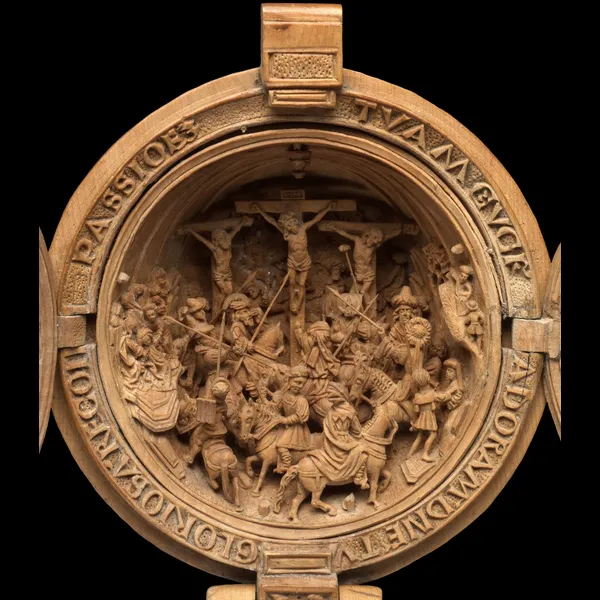
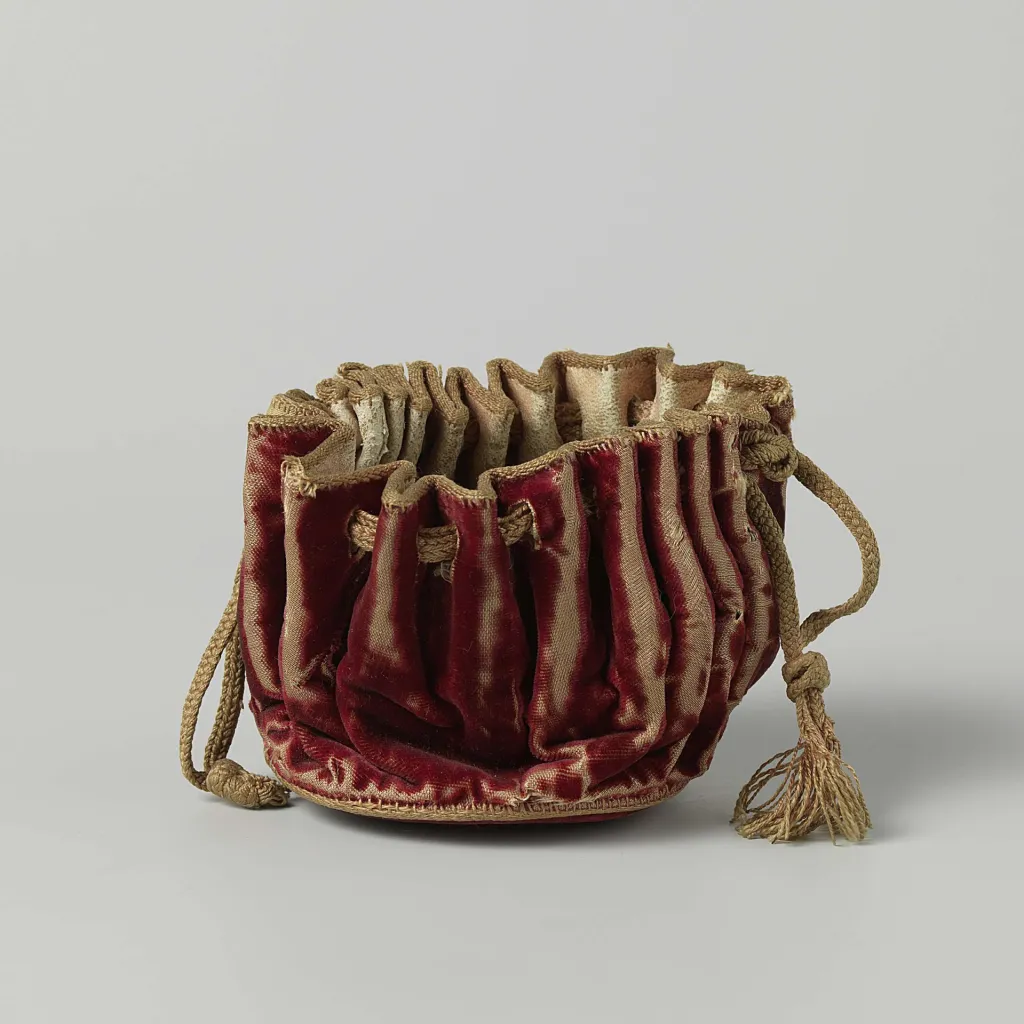
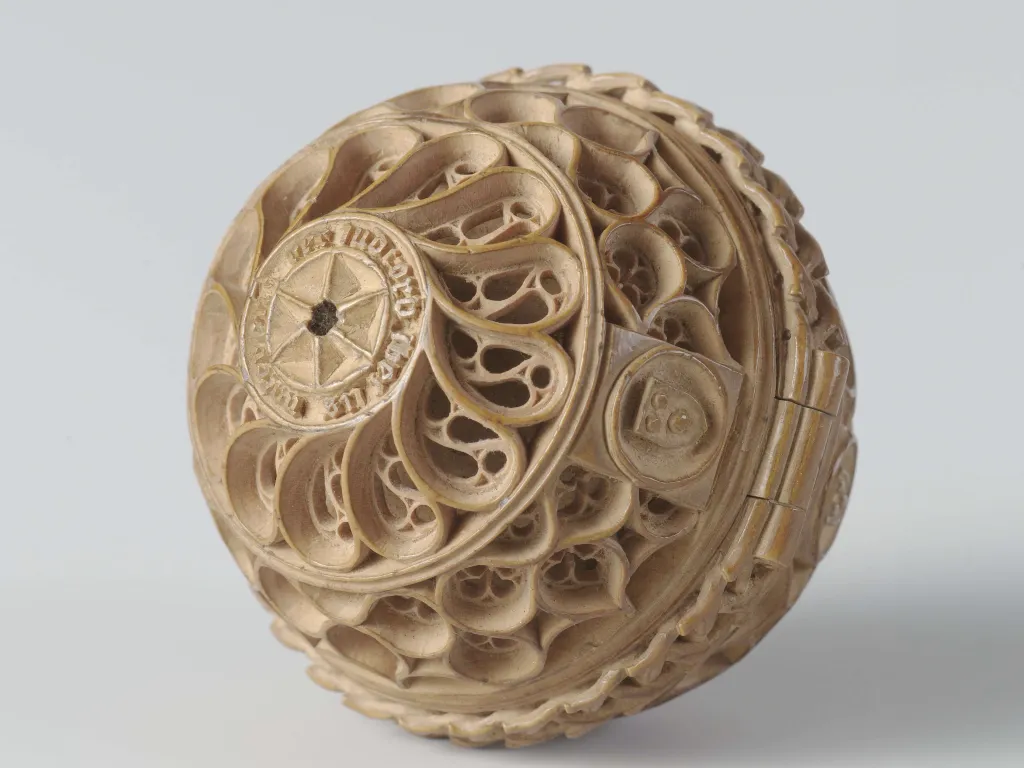
At the Rijksmuseum in Amsterdam, someone drew my attention to an object from the Middle Ages: a palm-wood sphere. It was divided into two halves. Both halves were very finely carved, revealing clear scenes. I remember the birth and crucifixion of the Lord Jesus. The shepherds and the wise men, men from the East. The two halves were joined together and could hinge open like a little box. The whole thing was housed in a copper sphere, which in turn was contained within a small leather pouch. The entire Gospel in a nutshell. It was clear that this had been made to be taken on journeys.
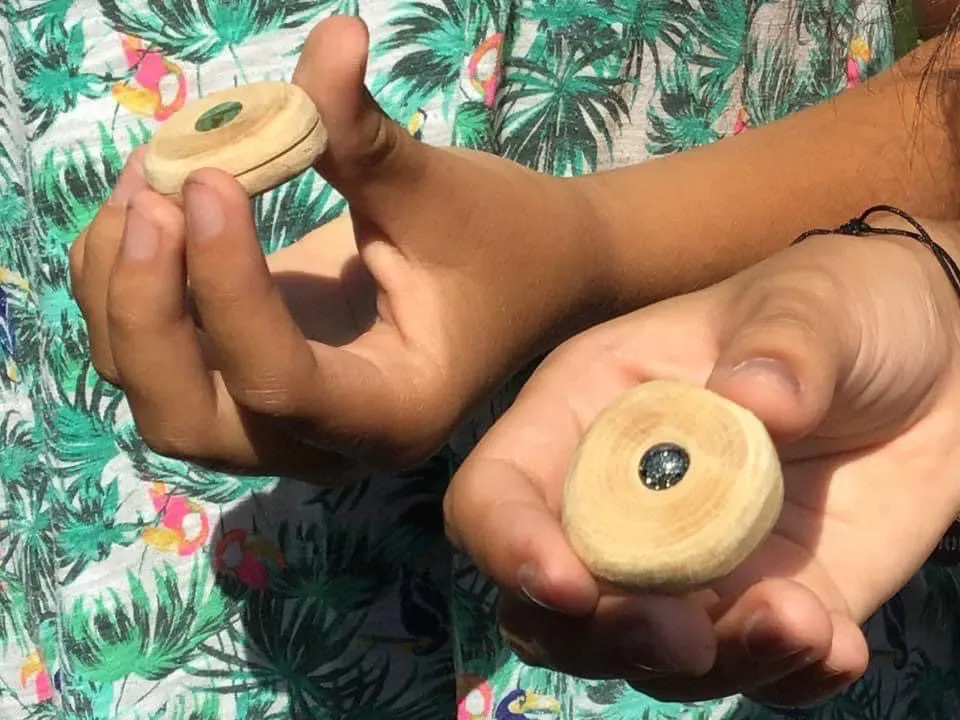
After some years, I came up with the idea of bringing this prayer nut back to life in a different way. Now it is flat and blank, and users can write their own prayer need in the nut with a pen, using a name, a date or a symbol. The nut is easy to keep, so you always carry your prayer with you. When your prayer has been answered, or you feel it has been in there long enough, take a piece of sandpaper and there is room for something new again.
Cultural heritage
Old prayer nuts are regularly exhibited, so they serve not only a historical but also an educational purpose.
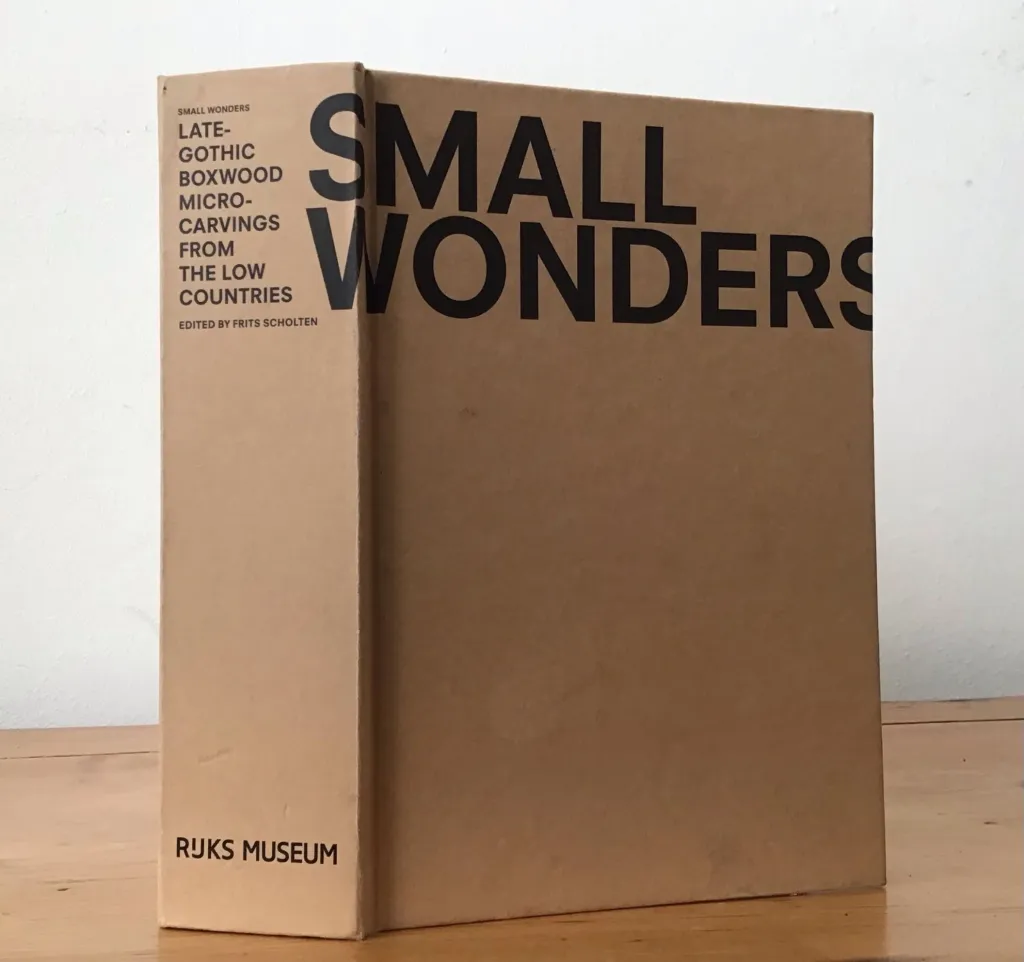
In 2017, the international exhibition “Small Wonders” was on display at the Rijksmuseum in Amsterdam. To mark the occasion, prayer beads I had made were sold in the museum shop and taken to all corners of the world. This provided a special and inspiring experience for thousands of visitors.
This travelling exhibition had previously been on display in Toronto, Canada (AGO, Art Gallery of Ontario) as ‘the boxwood project’. It then went on to the MOMA (Museum of Modern Art, New York) and Amsterdam. In early 2022, it will be on display at the Louvre in Paris.
The objects in the Small Wonders exhibition draw you in, however small they are.
Religious art
Around the year 1500, craftsmen and artists were active, particularly in the Southern Netherlands, who, often on commission, were engaged in the production of prayer nuts. In the Netherlands, one such craftsman was Adam Dirksz. Various examples of this woodcarver’s prayer nuts can be found in Dutch museums, including in Amsterdam (Rijksmuseum) and Utrecht (Catharijneconvent). Prayer nuts can be found in Bad Bentheim (Germany), Copenhagen (Denmark), Moscow (Russia), Toronto, New York, etc.
After my visit to the Rijksmuseum in 1983, I designed a ‘new’ prayer nut. It is simple in design and intended for everyday use.
In painting
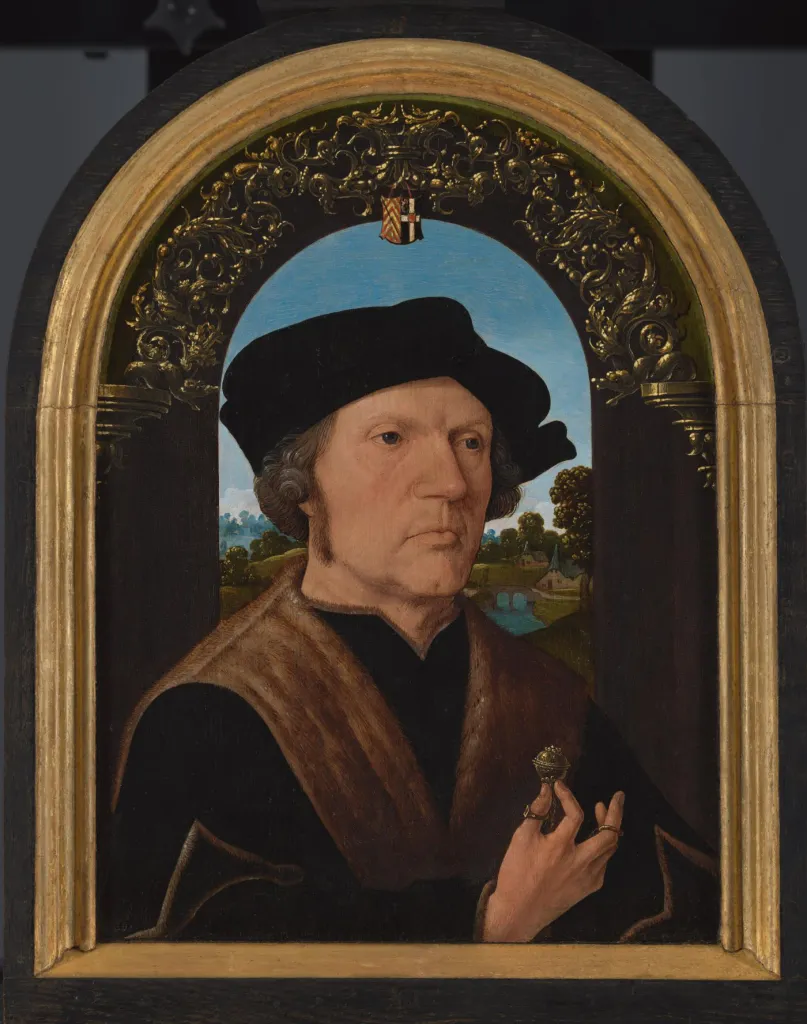
The prayer nut also features in painting. The Portrait of Jan Gerritsz van Egmond. In this painting by Jacob Cornelisz van Oostsanen, the nobleman depicted proudly holds a finely detailed, dark prayer nut between his fingers to demonstrate his wealth and piety to the viewer.
From the studio of Jacob Cornelisz van Oostsanen, Portrait of Jan Gerritsz van Egmond van de Nijenburg, c. 1518. Rijksmuseum, Amsterdam (public domain).
Frisian woodcarving
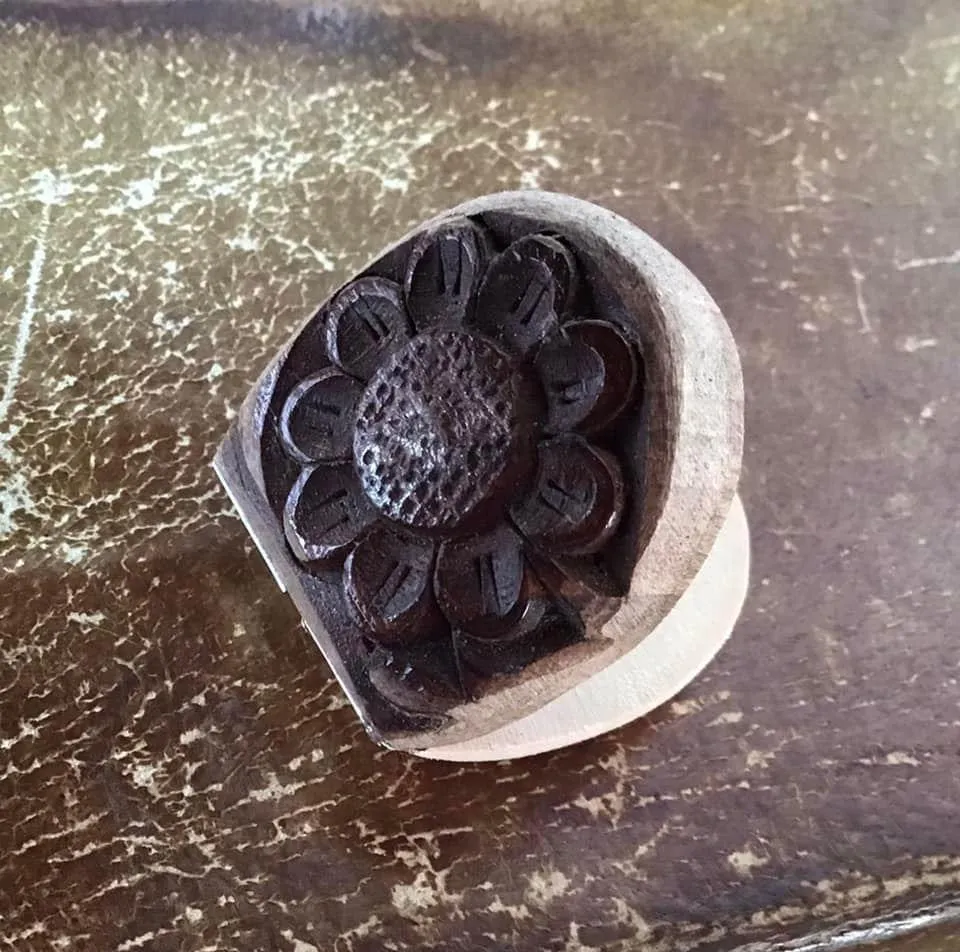
The geometric motifs were carved into this wood around 100 years ago. Around 1900–1920, there were times of crisis: unemployment affected many sailors, but also members of the armed forces. (The Netherlands did not take part in the First World War.) As a useful pastime, many people took up woodcarving.
Besides being decorative, the carved patterns had a religious meaning: the stars represented the starry sky and the interlaced knot symbolised Eternity. There is a resemblance to Celtic patterns. The central point from which everything seems to spring can be understood as the origin of life, the creation, God.
Answer to prayer
Various stories have been shared following the purchase of the prayer nut. Often, these were preceded by periods of (personal) distress. There were also stories of adventures that arose after a particular topic was included in the note. For example, a young woman wrote ‘New life’ in her note. A year later, God blessed her with a beautiful son. Her life has literally been renewed.
A girl of about eleven came over to my table with prayer nuts and some artwork. She really wanted to buy a pair of prayer nuts but didn’t have enough money with her. When I asked her why she wanted a pair of prayer nuts so much, she replied: “That way I can remember better who I want to pray for”. I asked her: ‘Do you believe that prayer can change things?’ She was convinced it could. I suggested she trust God to provide a solution to her financial situation. She agreed wholeheartedly. As we chatted, we felt God’s presence. She skipped off, only to return a few hours later with a smile on her face. Her pockets were bulging with small change. Astonished, I asked how she’d got hold of all that money. ‘Well,’ she said, ‘after I left, I had the idea of selling stickers, which were on offer everywhere during the event. Thanks to all those coins, I now have enough to buy the prayer nut.’
This is a wonderful example of simple faith, prayer and action. Of course, I could have just given her a nut, but then we wouldn’t have had this lovely adventure. God, our Father, is so close and so involved in everything that happens in our lives or that we hope to experience. God wants to be known and challenged through our prayers. Whether young or old, even when we doubt and aren’t quite sure – especially then!
Someone received ‘bad news’ about an illness. She ordered 14 little prayer nuts and shared them among her friends, asking them to pray for her healing. A few years later I was in touch with her again, and she told me that the illness had disappeared.
Read and see more
- Prayer nuts in the Rijksmuseum collection
- Prayer nut on Wikipedia
- The Boxwood Project, Art Gallery of Ontario, with many images
- Prayer nuts at the Metropolitan Museum of Art, New York
- Louvre, Paris: exhibition from 15 July 2021 to 10 January 2022